The State of AI Agents 2026: Endurance and Adoption
Global AI adoption remains niche, with only 0.15% of people using autonomous agents. We analyze the shift toward endurance and orchestration in 2026.
In 2026, AI agents have moved from speculative prototypes to critical infrastructure. The industry has shifted its focus from which foundation model is smartest to a more rigorous metric: endurance. Success is now measured by how long an agent can operate autonomously in production before requiring intervention or failing.
The Reality of Global Adoption
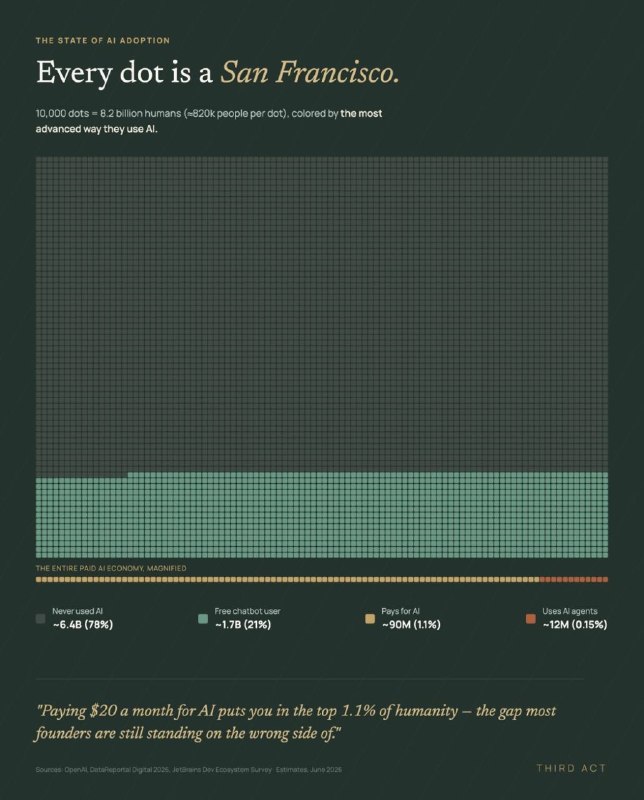
While AI dominates headlines, global usage remains in its infancy. Data from Third Act illustrates the scale of this divide. Out of 8.2 billion people, approximately 78% (6.4 billion) have never used AI. About 21% (1.7 billion) use free chatbots.
The paid AI economy is small but vital: only 90 million people (1.1% of humanity) pay for AI services. Of that group, the subset using autonomous AI agents is even smaller—roughly 12 million people, or 0.15% of the global population. Paying for AI currently places a user in the top 1.1% of humanity, a gap most founders still fail to bridge.
The Shift to Endurance
Intelligence has effectively commoditized. The real value has migrated to the orchestration layer—the harness that allows an agent to plan, execute, verify, and loop. As Nishikant Dhanuka of Prosus Group notes, the defining metric of 2026 is sustained autonomy. Modern frontier models now operate for nearly five hours on complex tasks, with task-length duration doubling every 196 days.
Code as the Universal Interface
The terminal has emerged as the unexpected general-purpose interface for autonomous work. Because coding agents, such as Claude Code, utilize terminal and filesystem access, they can manage software systems across domains. Any agent granted access to a shell and filesystem inherits the entire toolkit of the software development world, making "coding agents" the primary model for all agentic workflows.
Why This Matters
Production Readiness: We are past the demo phase. A 2026 survey of over 500 technical leaders found that 57% of enterprises now deploy agents for multi-stage, production-grade workflows.
The Orchestration Moat: When intelligence is a commodity, the defensible moat is the agentic harness. Context management, memory architectures, and sub-agent orchestration logic are where enterprise value now resides.
Multi-Agent Ecosystems: The industry is moving away from monolithic assistants toward specialized swarms. Newer frontier models use reinforcement learning to decide when to spawn sub-agents to handle specific sub-tasks.
Operator Playbook
Orchestrate Before You Automate: Build shared registries, identity controls, and hand-off patterns before deploying an agent. You cannot scale chaos.
Governance as Code: Do not rely on policy documents. Treat every agent as an identity-bearing entity. Hard-code its purpose, access limits, and kill-switches into the system architecture.
Redesign the Workflow: Do not bolt agents onto legacy, human-paced processes. Map high-friction processes and rebuild roles and approvals around the agent's autonomous capabilities.
FAQ
What differentiates an AI agent from a chatbot? A chatbot is reactive—it waits for a user prompt to generate text. An agent is proactive and goal-oriented; it breaks complex goals into sub-tasks, plans actions, calls external tools, and loops based on verification results without human intervention.
Why are enterprise agentic projects failing? Many projects stall because they attempt to apply autonomy to poorly structured data or rigid, legacy-bound workflows. Gartner estimates that over 40% of agentic projects may be abandoned due to unclear ROI or misapplied autonomy where human judgment remains necessary.
Sources & References
Prosus Group - "State of AI Agents 2026: Autonomy is Here" Anthropic - "Measuring AI agent autonomy in practice" Symphony Solutions - "AI Agents in 2026: The Future of Autonomous Software" Forrester - "The State Of Agentic AI In 2026: Companies Are Chasing, Few Are Catching" Dataiku - "Agentic AI tools in 2026: what to look for when choosing an enterprise-grade solution" Tommaso Maria Ricci - "Enterprise AI Adoption 2026: 88% Use AI, 39% See ROI"