Building the 2026 GTM Stack: The Shift from Legacy Tools to AI-Native Sales Infrastructure
Discover how to build a modern GTM sales stack for 2026. Explore the shift from legacy tools like Salesforce and Zapier to AI-native alternatives.
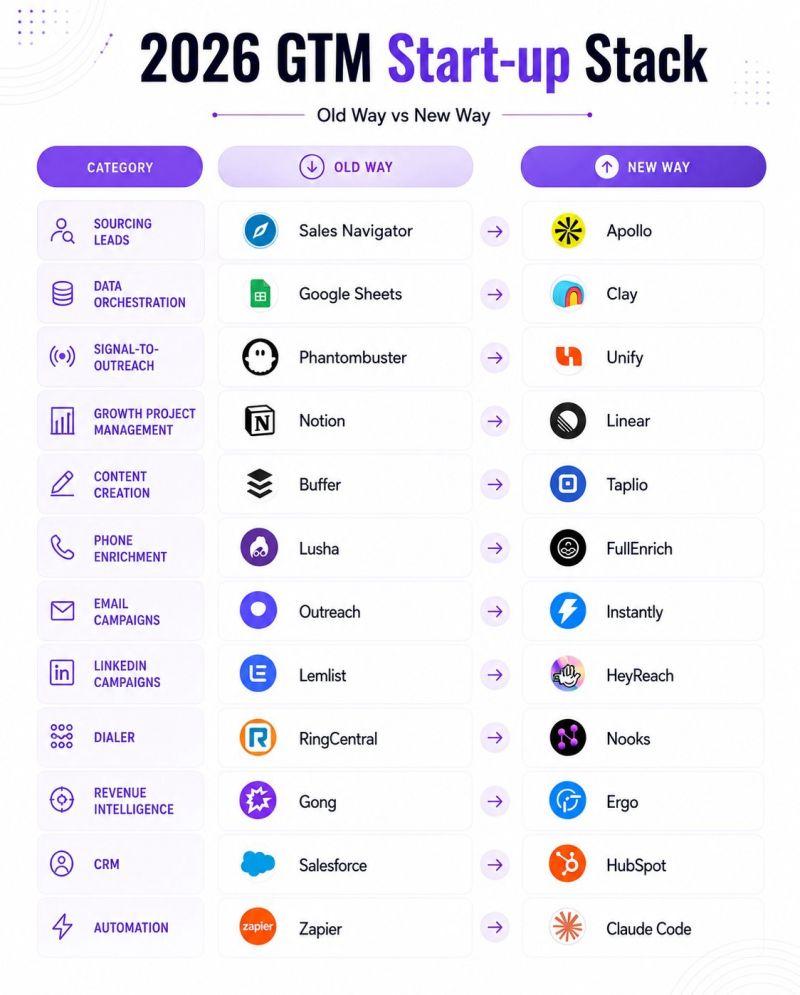
The 2026 Go-To-Market stack has fundamentally evolved from legacy software suites to lean, AI-native infrastructure. Startups are systematically replacing traditional tools like Salesforce, Outreach, and Zapier with modern alternatives such as HubSpot, Instantly, and Claude Code to maximize operational leverage and sales efficiency.
The Great GTM Unbundling
Building a high-performance modern sales and growth operation requires an entirely different software architecture than it did just a few years ago. The shift is defined by a move away from bloated, manual-heavy platforms toward nimble, automated systems designed for high-velocity execution.
According to the 2026 GTM Start-up Stack infographic analysis, every single layer of the startup go-to-market engine is undergoing a replacement cycle. This transition is not about incremental upgrades. It represents a total restructuring of how revenue teams source leads, orchestrate data, and execute outreach.
Sourcing and Data Orchestration
Legacy prospecting relied heavily on manual filters and static spreadsheets. The modern stack replaces Sales Navigator with Apollo for more dynamic lead sourcing.
More importantly, data orchestration has shifted away from basic Google Sheets into advanced orchestration layers like Clay. This allows operators to enrich target accounts using dozens of waterfall data providers instantly, removing the friction of manual list building.
Outreach and Campaign Velocity
Outreach automation has moved past rigid, enterprise cadence tools. In the new stack: Email Campaigns: Teams are migrating from Outreach to agile tools like Instantly. LinkedIn Campaigns: Lemlist is being replaced by specialized executors like HeyReach. Signal-to-Outreach: Phantombuster workflows are giving way to unified signal engines like Unify. Dialers: Traditional systems like RingCentral are being superseded by AI-driven conversation workflows in Nooks.
CRM and Workflow Automation
The core database layer is also standardizing. Startups are moving off enterprise legacy configurations in Salesforce and standardizing on HubSpot for cleaner pipeline visibility.
Meanwhile, back-end automation is moving beyond simple point-and-click webhook triggers like Zapier. Engineering-grade execution environments such as Claude Code are stepping in to handle complex data loops and operational workflows. Growth project management has similarly shifted from Notion to lightning-fast issue trackers like Linear.
Operator Playbook
Audit Your Stack:* Review your current software across the 12 key GTM categories and identify legacy tools that rely on manual human input rather than native AI automation. Adopt Waterfall Enrichment:* Replace static spreadsheets with a dedicated data orchestration tool like Clay to aggregate and clean prospect data automatically. Shift to Modern Execution:* Upgrade your outbound email and dialing infrastructure to high-velocity tools like Instantly and Nooks to increase daily touchpoints without scaling headcount.
Frequently Asked Questions
What is replacing Salesforce in modern startup GTM stacks?
Many early-stage and growth companies are utilizing HubSpot as their core CRM because it offers faster implementation, cleaner data structures, and tighter alignment with modern marketing and sales automation tools.
How has lead sourcing changed in the 2026 GTM stack?
Lead sourcing has evolved from static searches on Sales Navigator into automated, multi-signal workflows using platforms like Apollo combined with Clay for real-time waterfall data enrichment.
What tools are replacing traditional workflow automation?
Basic workflow builders like Zapier are increasingly being augmented or replaced by advanced developer environments and AI-native automation tools like Claude Code for complex operational tasks.
Sources & References
- Tour and attraction booking software - Singenuity - Background reference on software solutions and attraction management infrastructure.