Beyond the Token: OpenAI’s Outcome-Based Pricing Shift and the Road to GPT-Astra
OpenAI shifts to outcome-based pricing for major enterprise customers, charging only for completed tasks ahead of GPT-Astra.
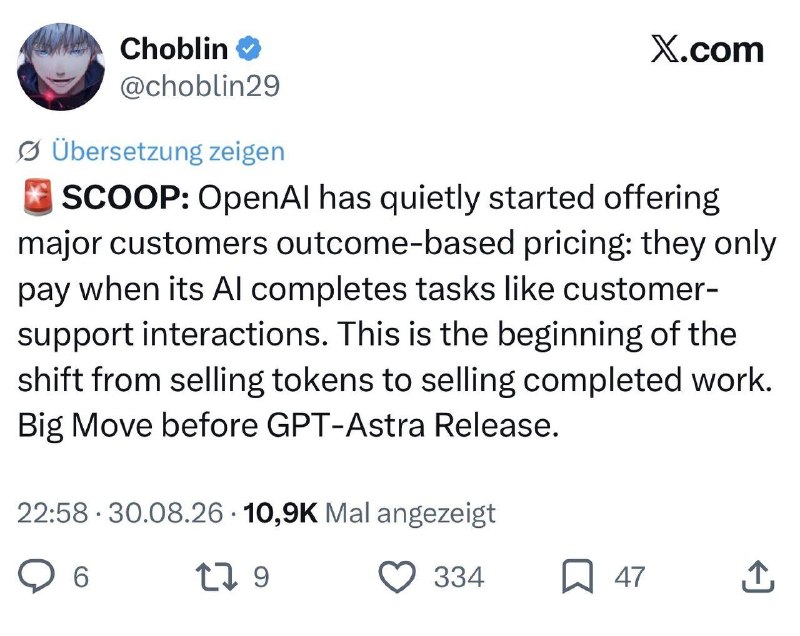
OpenAI is quietly shifting its business model from selling raw tokens to offering outcome-based pricing for major enterprise customers, charging only when specific tasks like customer-support interactions are successfully completed. This marks a fundamental evolution in software economics ahead of the rumored GPT-Astra release, moving value capture from compute consumption to guaranteed end-user results.
The Death of the Token Economy
For the past several years, the artificial intelligence industry has operated on a transactional utility model. Companies buy access by the token, paying for input and output characters regardless of whether the generated text drives revenue, resolves a ticket, or simply hallucinates a wall of polite prose. This raw compute model placed the financial risk entirely on the buyer. Enterprises had to optimize prompts, manage context windows, and absorb the cost of failed inference calls.
That era is officially coming to a close. According to a viral post on X by verified account @choblin29 on August 30, 2026, OpenAI has quietly started offering major customers outcome-based pricing [Choblin]. Under this new structure, enterprise clients only pay when its AI completes tasks like customer-support interactions [Choblin]. This is not a minor pricing tweak. It represents an existential shift in how software utility is monetized.
Shifting Risk to the Provider
When an AI vendor charges per token, they are selling raw ingredients like flour and yeast. When they charge for completed tasks, they are selling fully assembled sandwiches.
This transition fundamentally alters enterprise procurement: Guaranteed Utility: Buyers no longer pay for trial and error. If an automated customer support agent fails to resolve an inquiry, the enterprise incurs zero cost for that interaction. Operational Alignment: Vendors are forced to ensure their models are hyper-reliable and domain-accurate. A low-performing model now directly hurts the provider's bottom line through wasted inference compute. Higher Margins for High-Performance Systems:* Highly capable models can command a premium per completed task because the labor replacement value is immediately quantifiable by CFOs.
The Setup for GPT-Astra
This pricing evolution is happening in the shadow of broader industry rumors, specifically pointing toward an unreleased product tentatively dubbed "GPT-Astra" [Choblin]. Transitioning to outcome-based pricing right before a major flagship release is a masterclass in market positioning.
By proving that their systems can autonomously drive business outcomes at scale, OpenAI is removing the final barrier to enterprise adoption: fear of unpredictable cloud compute bills. When founders and media operators evaluate automation tools, the question is no longer about parameter counts or context lengths. The only metric that matters is cost per successfully executed workflow.
Operator Playbook Audit your AI vendor contracts:* Stop evaluating software strictly by API costs or token pricing tiers. Shift your procurement focus toward metric-driven SLAs and task-completion guarantees. Redesign internal workflows for autonomy:* Prepare your operational stack for task-based pricing by isolating discrete, automatable business processes like level-one support or lead routing where success is binary and easily measured. Demand outcome accountability:* As enterprise vendors follow OpenAI's lead, refuse to pay for failed inferences or raw compute overhead. Force your technology partners to share the operational risk.
Frequently Asked Questions
What is outcome-based pricing in artificial intelligence?
Outcome-based pricing is a commercial model where enterprise buyers pay AI providers only when specific, quantifiable tasks—such as resolving a customer support ticket—are successfully completed, rather than paying for raw tokens or compute time.
Why is OpenAI shifting away from token-based pricing?
Shifting to outcome-based pricing removes financial risk for enterprise buyers, encouraging faster adoption and higher-volume deployment by aligning the vendor's revenue directly with verifiable business results.
What is GPT-Astra?
GPT-Astra is an unreleased product referenced in industry reports surrounding OpenAI's strategic shift toward advanced, task-oriented enterprise automation.
Sources & References
- [X (@choblin29)] - "Scoop: OpenAI has quietly started offering major customers outcome-based pricing..." (August 30, 2026)