The Great American Population Redistribution: Which States Are Winning and Why
Explore the great American population shift: Texas and Florida capture 62% of growth while legacy states decline. Key data, tech adoption, and strategy.
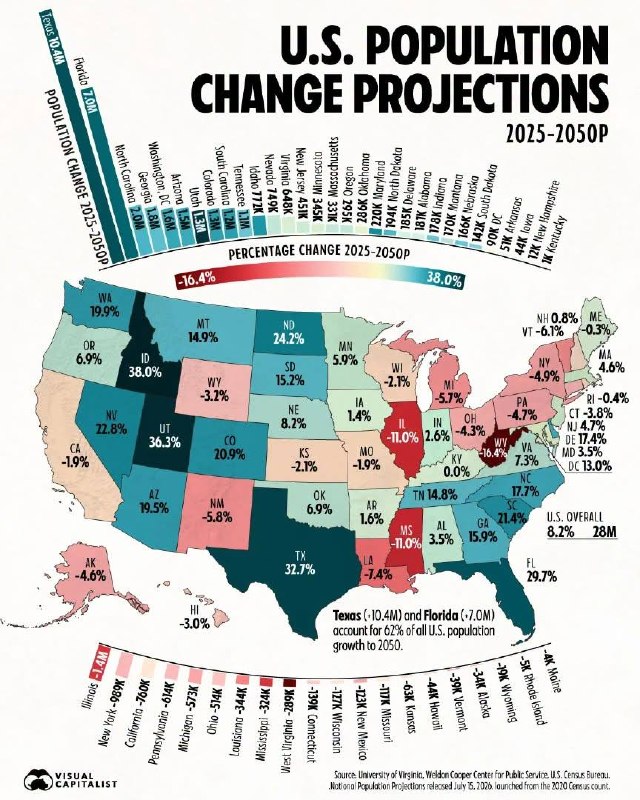
The great American demographic reshuffle is rewriting the rules of economic power, with Texas and Florida alone projected to capture 62% of all U.S. population growth through 2050 according to Visual Capitalist data. This massive structural migration is permanently altering state tax bases, corporate investments, and political influence.
The Tale of Two Geographies: Growth vs. Decline
The latest data from the University of Virginia Weldon Cooper Center for Public Service and the U.S. Census Bureau paints a vivid picture of American economic gravity shifting toward the Sun Belt. States like Idaho are projected to surge by 38.0%, Texas by 32.7%, and Florida by 29.7%. In absolute terms, Texas leads the nation with a projected +10.4 million new residents, followed closely by Florida at +7.0 million.
Conversely, legacy industrial and coastal powerhouses are facing unprecedented structural shrinkage. Illinois is slated to lose 1.4 million residents (-11.0%), New York faces a drop of 989,000, and California is projected to shed 760,000 people.
The Tech Adoption and Wealth Divergence
This population redistribution is not happening in a vacuum; it runs parallel to a profound shift in digital capability and wealth concentration. According to the Anthropic Economic Index published by Visual Capitalist, artificial intelligence adoption heavily indexes around traditional political and innovation hubs. Washington D.C. leads the nation with a 4.00x multiplier relative to its working-age population, followed by New York at 2.68x and California at 1.48x, while rural states like West Virginia lag at 0.25x.
At the same time, wealth distribution remains anchored to massive metropolitan centers. RentCafe and WalletHub data on millionaire renter households shows New York leading with 5,661 households earning over $1 million annually, trailed by San Francisco with 1,411. Yet, as families and scalable businesses migrate southward and westward, the friction between legacy capital concentration and emerging high-growth infrastructure corridors creates an urgent mandate for founders and operators.
Operator Playbook
Audit your geographic footprint:* Evaluate whether your customer acquisition, talent pipeline, and physical operations are aligned with high-growth corridors like Texas and Florida, or over-indexed on shrinking tax bases. Capitalize on regional tech disparities:* Deploy advanced tooling and AI workflows in emerging markets where digital adoption creates an immediate competitive moat against slower-moving legacy competitors. Monitor export-driven logistics:* Align your supply chain strategy with regional export patterns, keeping a close eye on primary trade corridors highlighted by U.S. Census Bureau export data.
Frequently Asked Questions
Which states are gaining the most population through 2050? According to projections from the University of Virginia Weldon Cooper Center and the U.S. Census Bureau, Texas and Florida are leading the nation, capturing 62% of all U.S. population growth with gains of 10.4 million and 7.0 million residents respectively.
Why are traditional tech hubs still dominating AI usage? Data from the Anthropic Economic Index shows that political and financial centers like Washington D.C. (4.00x) and New York (2.68x) heavily outpace the national average in relative AI usage due to their dense concentrations of knowledge-worker industries.
How does population redistribution impact business operators? Shifting demographics alter local talent pools, consumer spending power, and state-level tax environments, forcing founders to continuously re-evaluate where they build physical infrastructure and deploy capital.
Sources & References
Visual Capitalist - "U.S. Population Change Projections 2025-2050P" via University of Virginia Weldon Cooper Center and U.S. Census Bureau Visual Capitalist - "Claude AI Usage by State" via Anthropic Economic Index * WalletHub / RentCafe - "Cities with the Most Millionaire Renters"