When the Internet Funnel Breaks: Why AI and Cloud Stacks Keep Falling Over
Widespread AI and cloud outages are symptoms of internet centralization. Here is why the stack collapses and how founders can build for genuine resilience.
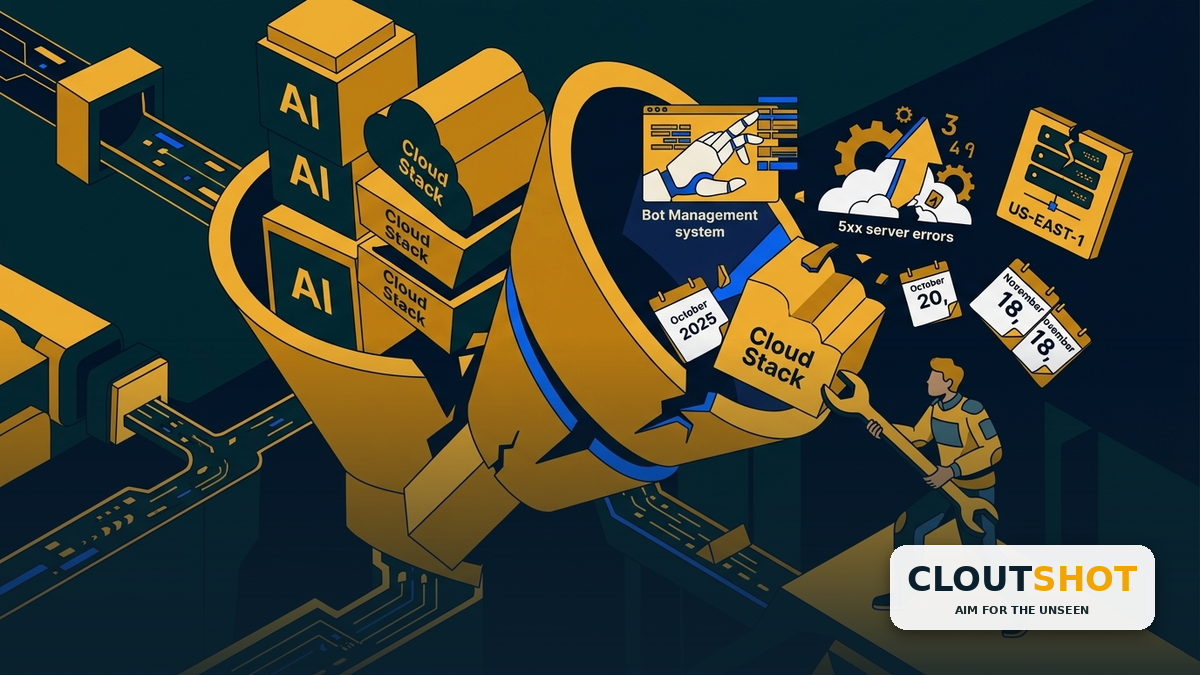
The fragility of the modern internet is not a failure of innovation, but a symptom of extreme consolidation. When critical web infrastructure like AWS and Cloudflare suffers internal configuration errors, the blast radius is global, instantly freezing everything from AI agents to smart furniture. Resilience requires decoupling these centralized dependencies.
The Infrastructure Trap
The internet today functions less like a distributed network and more like a funnel. A massive share of global web traffic relies on a handful of providers for DNS, CDN, and security layers. When these providers stumble, the impact cascades instantly.
According to reports on the November 18, 2025 Cloudflare outage, a single internal configuration change caused a feature file in the Bot Management system to double in size. This file exceeded hard-coded limits in the proxy software, triggering global 5xx server errors and freezing platforms like X, ChatGPT, and Canva.
Similarly, the October 20, 2025 AWS outage—caused by a latent DNS race condition in US-EAST-1—knocked over 3,500 companies and affected services in over 60 countries for nearly 15 hours. The failure of these "trusted" systems demonstrates that internal configuration errors are now higher-risk events than most external cyber threats.
Why Centralization Multiplies Risk
Modern architectures prioritize efficiency and rapid global deployment, often at the expense of regional isolation. When services are tightly coupled to a single provider’s control plane, an outage in one region—like US-EAST-1—can degrade performance globally, even for services hosted in supposedly redundant regions.
This consolidation creates hidden dependencies. Applications rely on SaaS tools, APIs, and libraries that all funnel traffic through the same infrastructure bottlenecks. When the underlying layer fails, your own systems crash not because they are broken, but because they can no longer reach the dependencies they require to function.
Operator Playbook: Building Resilience
- Implement Local Fallbacks: Ensure critical functions—like smart home controls or basic app workflows—operate via local protocols (e.g., Bluetooth, local network) when the internet link drops. Do not assume your provider is always available.
- Audit Your Dependency Chain: Map every third-party service your platform calls. If your primary DNS, CDN, or auth provider fails, identify exactly what parts of your system will freeze and build a "dead-man’s switch" or bypass path for them.
- Architect for Provider Diversity: For mission-critical traffic, move beyond single-provider setups. Utilize multi-CDN or multi-cloud strategies where traffic can be rerouted in real time without relying on a single company's control plane.
Frequently Asked Questions
Q: Why does a single company's bad update break the whole internet? A: Because these providers operate at a scale where they handle a vast percentage of global traffic, and their systems are highly interconnected. A single misconfiguration propagates globally in seconds, turning a minor internal mistake into a total network failure.
Q: Can more data centers prevent these outages? A: Not on their own. Simply increasing the number of data centers does not solve the underlying issue of centralized control. Resilience requires policy-driven, multi-provider, and multi-region architectures that can isolate failures and reroute traffic independently of any single vendor.
Sources & References
DevOps.com - "Three Key Lessons from the Recent AWS and Cloudflare Outages" SmarterArticles - "Your Bed Needs the Internet: How Cloud Dependence Endangers Everything" Deployflow - "Cloudflare Outage: What It Means for Your Cloud Infrastructure" TechCrunch - "Cloudflare outage takes down X one month after Musk mocked AWS customers"